Living Room Interior Design: The Complete Guide
Living room design comes down to a handful of decisions: rug size, furniture arrangement, curtain height, lighting layers, and color palette. Get these right and the room works — regardless of style. This guide answers the ten most common living room design questions with direct, practical answers you can apply today.
What size rug should I get for my living room?
Your rug should be large enough that at least the front legs of your sofa and chairs sit on it. In most living rooms, that means an 8x10 or 9x12 rug. A rug that is too small makes the seating area feel disconnected and the room feel smaller.
If your furniture is floating in the middle of the room (not against a wall), all four legs should sit on the rug. Leave 12 to 18 inches of floor visible between the rug edge and the walls.
How should I arrange furniture in a living room?
Start with the focal point — a fireplace, a view, or a media wall — and orient the furniture toward it. The sofa should face the focal point, with chairs angled to create a conversation area.
Aim for a distance of 3 to 8 feet between seating pieces. Closer than 3 feet feels cramped; farther than 8 feet feels disconnected. Leave at least 18 inches of clearance for walkways.
How high should curtains be hung?
Hang curtains as close to the ceiling as possible — ideally 4 to 6 inches below the ceiling line, or directly at the ceiling if you have standard 8-foot ceilings. Extend the rod 8 to 12 inches beyond the window frame on each side.
This makes the window look larger and the ceiling feel higher. It is one of the most impactful and least expensive changes you can make.
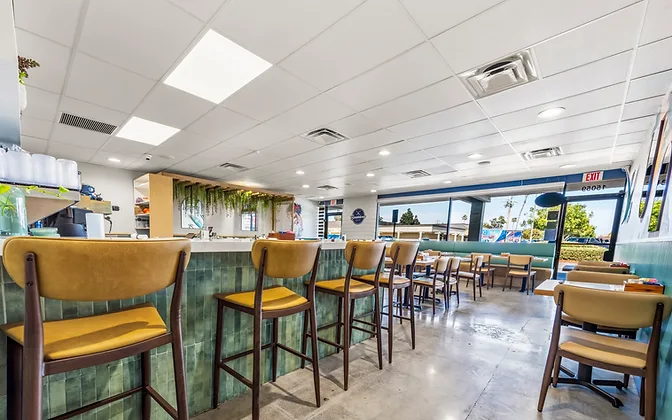

See how we layered lighting and materials in our Bandoleros Cafe project. For more on this and other tricks, see our small space design ideas.
What size coffee table do I need?
Your coffee table should be about two-thirds the length of your sofa. A standard sofa (84 inches) pairs well with a coffee table that is 48 to 56 inches long.
Leave 14 to 18 inches between the sofa and the coffee table — enough to walk through but close enough to reach a drink. The table should be the same height as or slightly lower than the sofa seat.
How do I make a small living room look bigger?
Use furniture with visible legs (light passes underneath), hang curtains high, keep a light monochrome palette, and use a mirror opposite a window. Avoid oversized furniture and keep sightlines clear. See our full guide on small space design ideas for all twelve tricks.
How do I choose a color palette for my living room?
Use the 60-30-10 rule: 60% dominant color (walls), 30% secondary (upholstery or rug), 10% accent (pillows, art). Start with a neutral base and add personality through accent pieces. See our guide on how to choose paint colors for a full framework.
How many light sources should a living room have?
At least three: ambient (overhead or recessed), task (reading lamp or floor lamp), and accent (wall sconce or picture light). A single overhead light makes the room feel flat. Multiple sources create depth and let you control the mood.
Should living room furniture match?
No. Matching sets make a room feel like a furniture showroom. Instead, choose pieces that share a common element — a color, a material, or a period — but vary the form. A modern sofa with a vintage chair and a wood coffee table creates more interest than three pieces from the same collection.
How do you mix wood tones in a living room?
Mix wood tones by contrast, not by trying to match. Pair a light oak floor with a dark walnut table. The key is to have at least two distinct tones (not a muddy middle) and to repeat each tone at least twice in the room so it feels intentional.
How high should you hang artwork above a sofa?
Hang artwork so the center of the piece is 57 to 60 inches from the floor — eye level for the average person. The bottom of the artwork should be 6 to 8 inches above the sofa back. If the piece is very large, it can sit closer to the sofa; if it is small, group it with other pieces to fill the space.
If you are redesigning your living room and want professional guidance, we can help. For broader design context, see our guide on modern interior design.

Frequently asked questions
Design your living room
Get in touchHow to Make a Small Space Look Bigger: 12 Designer Tricks
12 designer tricks to make a small space look bigger — mirrors, monochrome palettes, leggy furniture, curtain height, and more. No renovation needed.
How to Choose Paint Colors for Your Home
Learn how to choose paint colors with confidence — undertones, the 60-30-10 rule, testing swatches, and building a whole-home palette that flows.
Modern Interior Design: Ideas, Materials, Colors & Examples
Modern interior design explained — materials, colors, and room-by-room examples. Learn what makes a space modern vs. contemporary vs. mid-century.
 Translate